
.svg)
.svg)
.svg)
.svg)
.svg)
.svg)
.svg)
.svg)
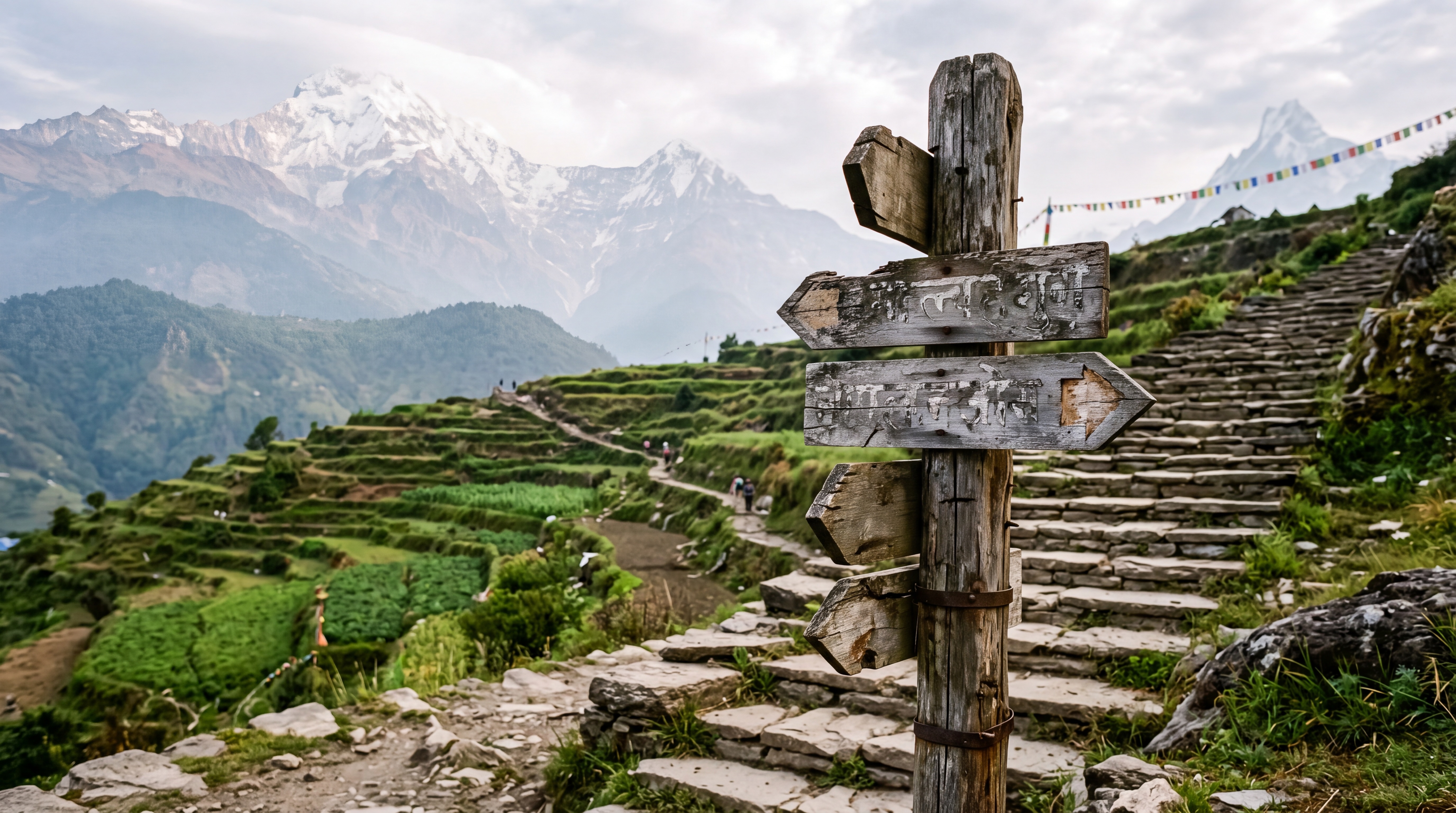
Before any of us signed a building, the Himalaya was already running the most reliable wayfinding system on earth. Millions of strangers a year, no power, no maintenance contract, no app. A painted stripe on a rock, a stack of stones, and a teahouse aunty pointing with her chin.
Nepali Standard Time
First, the phrasebook every trekker learns the hard way:
- "One hour to the next village": three hours. It is always three
- "Just there": visible, yes. Also a vertical kilometre away
- "Flat trail ahead": Nepali flat, gently up, savagely up, then down
- "Almost there": a philosophical position, not a distance
"'One hour' is not a measurement. It is encouragement."
The system that never fails
And yet nobody stays lost. The trail marks itself: a red and white stripe painted at every junction, cairns stacked where cloud swallows the path, prayer flags telling you the pass has arrived. The route itself is the record, worn into the ground by ten thousand feet that chose the same line. Desire paths, promoted to infrastructure.
No electricity. No firmware updates. Maintained by everyone who walks past. Uptime measured in centuries.
What the trail teaches the terminal
Mark the decision point, never the space between. Keep one mark language the whole route, so trust compounds with every junction. And design the recovery: on the trail, lost means walk back to the last stripe. A building should forgive you the same way.
Above all, the trail designs for tired people at altitude, and that is exactly who walks into our buildings: the late passenger, the stressed patient, the first-day student. Every space we sign is chasing the clarity of that stripe on the rock. When it works, nobody notices, and everybody arrives. Just there. One hour.





End to end.

